

Description
Discover the Heart of the Netherlands
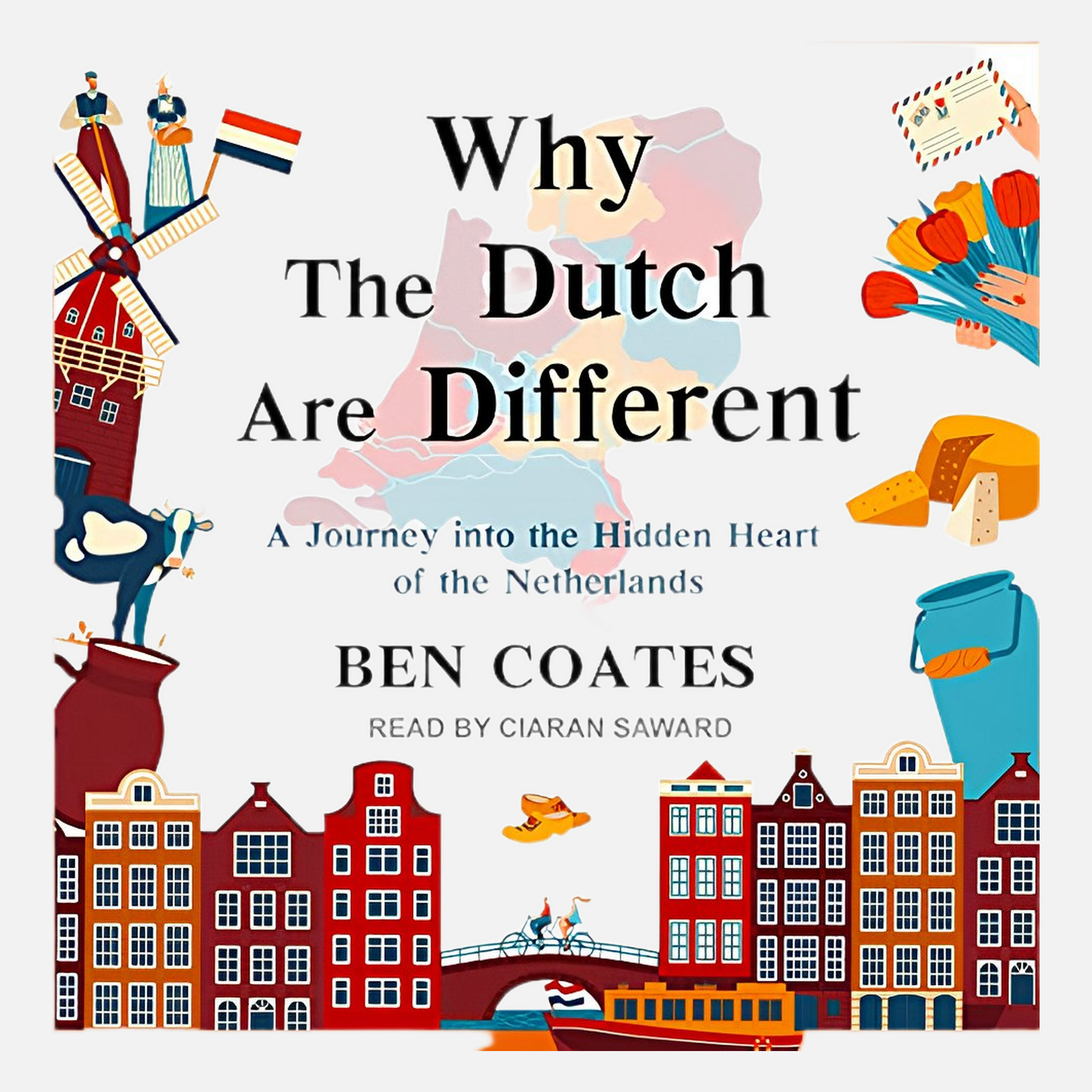
Stranded at Schiphol airport, Englishman Ben Coates didn’t just find dinner; he found a new life. In his amusing yet insightful travelogue, Why the Dutch Are Different, Coates explores the quirky charm, rich history, and surprising complexities of his adopted homeland, the Netherlands.
The Curious Case of Being Dutch
Ever wondered why the Dutch are the tallest people on earth or why they dominate carnivals (second only to Brazil)? From the iconic color orange to their enviable work-life balance, Coates ventures into the heart of Dutch culture. Expect hilarious, touching revelations on everything from Amsterdam’s changing red-light district to the true story behind Anne Frank’s betrayal.
A Fresh Perspective, A Fascinating Journey
Blending history, humor, and personal anecdotes, this book is as captivating as the country itself. Whether you’re a trivia buff, a history nerd, or someone who just appreciates sharp wit, Why the Dutch Are Different is your ticket to understanding a nation that’s small but punches well above its weight.



Sue –
Excellent choice for book on The Netherlands.
Provides selected historical background in a highly readable, interesting way.
Vmp –
A memoir and guide book in one
4.5 stars. I started reading Why the Dutch are Different a while ago and have just finished it now. At first I wasn’t sure whether it was memoir, history, social comment or what it was, but actually it’s a mixture of all three.Ben Coates is a young Englishman who was formerly in the hectic political world of the UK. As a speech writer and lobbyist, I am sure he must have been used to viewing the world through a critical lens. This book is a reflection of his ability to stand back and look at the Netherlands without any rose-tinted glasses on, something I think I would find hard to do myself as I tend to want to focus on the positive aspects of life wherever I have lived it, and of course I’ve lived in the Netherlands for nearly seventeen years.First and foremost, let me say Ben Coates is an exceptionally good writer. His flexible use of English in his keen perceptions on the Dutch, their history and their customs is perfect and I often stopped reading simply to admire a sentence or phrase that seemed particularly apt or succinct. There were, however, quite large sections of the book I felt tempted to skim over. For those who don’t know much European, and specifically Dutch, history, this book gives a kind of potted summary of many of the important periods in the country’s past. For these people, it will probably be useful; for myself, I could have done without quite so much straying into the activities of the VOC (the East India Company), King William’s exploits into England and the history of the Spanish and French domination of the Netherlands. This was all background I studied at school and university and unfortunately, it didn’t really strike me as anything more than just reeling off the facts; nor did it seem to have much to do with why the Dutch are different now, other than setting the historical background for the country’s great reputation as a trading nation that supported the arts in its Golden Age. On the plus side, I learnt a lot of fascinating little gems, such as why the city of Breda got its name (the breede Ee, meaning the wide river Ee) and other such titbits. I found myself frequently asking my Dutch partner ‘Did you know this?’ and often he didn’t, so for all those interesting snippets, I was very grateful.Strangely enough, I enjoyed the section on the Dutch obsession with football. I’m not a football fan at all, but the fanatical devotion the Dutch have to soccer is a curious phenomenon in this country and I found the accounts he gave of the teams, the key players and managers and both the national adoration and criticism that the Dutch have for their footballers really entertaining. However, most of all, I enjoyed the later chapters where he writes about how the intrinsic Dutch culture of ‘anything goes’ has been tested in recent years by what opening borders and increased immigration have meant to the Netherlands. He writes lucidly and honestly about how this has affected the traditionally relaxed attitude Dutch have had to drug use, prostitution, homosexuality, euthanasia and immigration.All this quite intense discussion is set against the background of Ben Coates’ own experience as he travelled around the Netherlands during his early years in the country and while he makes few personal judgements until quite close to the end of the book, he tells things like they are. I must say I quite often wondered if he even liked it at all; that was until I reached the final chapter, when I realised that he, like me, appreciates how much our easy, breezy self-confident and optimistic Dutch hosts have to offer. He also shows how fond we can become of these smiling, but direct people who fully espouse their ‘philosophy of a flat country’. As I said at the beginning, this book is part memoir, part history lesson and part editorial. Overall, it is a really good read and I learnt a lot from it and I am now looking forward to reading his new book about the Rhine, which is apparently due out soon.
67 people found this helpful
KC L –
Now I know why the Dutch are different . . .
Had a lighthearted armchair trip to the Netherlands with Ben Coates during Covid Christmas 2020. His writing style suits me perfectly: witty, insightful, down-to-earth. There’s enough history and geography to help an American reader connect the dots (make sense of the scattered bits and pieces of Dutch facts and stereotypes we know about) without bogging down in excess detail. His Englishman’s observations about Dutch personality traits, values, and interactions with foreigners had me laughing out loud. Fascinating to learn of the similarities in the way immigration issues there resemble what we struggle with here. In both countries hate and tolerance vie for dominance, with hate nosing forward in disturbing ways. He’s an astute observer of Dutch life and is candid about how his own political views evolved over years, the result of living and traveling among the Dutch. He does so without taking sides in an offensive manner. I came away admiring the Dutch greatly for their creativity, innovation, and openness, while recognizing their oppressive colonial history. After reading Why the Dutch are Different, I am more determined than ever to spend an immersive vacation in the Netherlands as soon as it is again safe to travel.
23 people found this helpful
TreeSaw R –
Interesting read!
I enjoyed this book. I read it after going to the Netherlands and this book makes me want to go back to see a few of the places the author mentions that I didn’t see the first trip. Worth the read!
Robert T. Flynn –
Good quick introduction to The Netherlands
It’s a book that aims to provide an overview, not deep analysis, and it succeeds at that. Probably the most interesting chapter for me, because it is the subject that I knew the least about, was the description of the Dutch obsession with soccer/football.
5 people found this helpful
00Severijn –
Worth it, though not without its flaws
The subject matter is interesting, and it was a good idea to weave history with travelogue. Glad to have read it; the experience ultimately led me to reference other books and google many topics in order to learn more about the Dutch. The less than perfect rating comes down to disliking Coates’ writing style–there’s nothing special about his use of the English language (ample repetition of certain words), there’s an irreverence (or disdain? Or cynicism?) he seems to hold for humans that rears its head oftentimes without any charm, and his constant descriptions of women as “busty,” “attractive,” “skinny,” etc. are distracting and lazy.
3 people found this helpful
Stela Marinova –
You have to read
This book is very interedting. It makes to understand the other culture easy.
D. Roe –
Really Enjoyed
I initially picked this book up because I thought it sounded interesting. I have an interest in many European countries and their cultures, so it just seemed natural to read a book like this for me.Even thought history often is not my personal interest, I found that Ben Coates was able to describe Dutch culture and the history that led up to it in a way that I found both interesting and entertaining. The author has a rather enjoyable sense of humor, and I learned a lot about the Netherlands that I never would have expected. I’ve never been there before, but this book put the country at the top of my travel list. Great work!
7 people found this helpful
F. Moyer –
The Netherlands: Geography, History, Culture and Social Attitudes
This book was written by a 20-something English man who had spent the last 5 years living and working in The Netherlands. When the author could find some time to travel within The Netherlands, he would describe the places he visited, provide information on the local history of the region and philosophize about the attitudes of the people living there. He also watched (and sometimes participated in) some of the local festivities as well as some of the national Dutch holidays. So the book was written from an outsider’s viewpoint of the Dutch people, though also certainly from a sympathetic viewpoint,“Why the Dutch are Different” is a catchy title. But for the people of any region, the basic influences that tend to define them as a class of people are [1] the geography they find themselves inhabiting, [2] the long history of their region, [3] the cultural experiences they were exposed to while growing up and [4] the typical daily interactions that occur between friends, neighbors & casual acquaintances. And that, of course, is what the author actually wrote about.The book has 7 chapters plus an epilogue. The chapters (and their primary focus) are:[1] Water, Water Everywhere (geography)[2] The Religious Divide (invading army history)[3] The Golden Age (economic history)[4] Fire and Ashes (World War II history)[5] Total Football (soccer, a national mania)[6] Mosques on the Maas (immigration’s impact)[7] Anything Goes (tolerance and liberal attitudes)The Epilogue, though short, was the most entertaining part because the author’s love for The Netherlands really shined through. In comparison, most of the chapters consisted of dispassionate descriptions of places, people, histories and current not-yet-resolved national issues.One of the most interesting issues to me was the struggle to incorporate Middle East immigrants, with their very conservative and restrictive treatment of females, into the Dutch national culture, with its very liberal and tolerant social mores (including legalized prostitution). Never having had much interest in soccer, the fact that an entire chapter (out of a total of only 7 chapters) was devoted to soccer seemed a bit crazy.The book would have been a bit easier to read if a few humorous observations had lightened the task of reading. And having a few pictures, to accompany the descriptions, would have been nice, too.Bottom Line: Okay, but somewhat dry as descriptions of the joy of living your life in The Netherlands was strangely limited to the Epilogue.
Mark –
Well Written, Well Researched
Always interested to see what the non-Dutch have to say about the Netherlands, I quite enjoyed Ben Coates’ take on my home country. He writes well, and did his homework, which is to say I think he did a great job with alternating between personal observations and providing historical explanations. And yes, I learned a few things about Dutch history as well.I don’t understand the complaints in some reviews about his supposedly negative take on the Netherlands when he speaks so highly of it in general. The few points of criticism he levies at the Dutch are his opinion based on actual facts. Disagree with him all you want, but that doesn’t make the factual basis for his opinion incorrect. I certainly do not understand the “racism” & “racist” claims in some other reviews. Just because he describes phenomenon that are simply factual and admits to being annoyed himself by certain aspects of mass immigration to the Netherlands does not make it racist. In fact, one could argue it is exactly such baseless accusations that have made debating these issues in the Netherlands so hard.So I enjoyed it very much.
11 people found this helpful